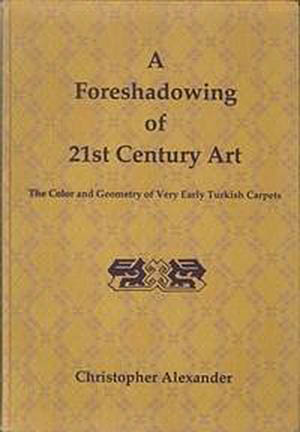
For many years Christopher Alexander, like an obsessed Sherlock Holmes, spent much of his energy, time, and income in the search for rare rugs. His collection of early (13th to 15th century) Anatolian carpets is now one of the finest and well known in the world.
He studied these carpets. He analysed and sketched the intricate patterns to understand exactly how they were formed. He observed how colors were juxtapositioned by the weavers and worked more himself with paint.
These carpets were his most important teachers. They taught him color. They taught him geometry. They taught him that only the weavers who stretched beyond themselves to the prayers for which they were made, actually reached real artistic force.
This book tells the story of the collection and the story of the lessons that bridge more than 500 years.
***
|
|
Part 1: The Beauty of Early Turkish Carpets
|
|
The great carpets were not secular objects of beauty. The inspiration, motivation and purpose was to reach the infinite and express the metaphysical principle of Unity. This motivation was the source for the geometrical structure of the rugs with border and window. The 'void' glimpsed through the "window" pointed toward the "the truth that God is completely beyond all that the ordinary mind and the senses can conceive as reality." The arabesque "removed from the eye the possibility of fixing itself in one place and from the mind the possibility of becoming imprisoned in any particular crysallisation of matter. . ."
This motivation was the source of the intensity of structure requiring every tiny knot of 1/8 of an inch to contribute to a well formed shape. Colors were placed so that they brought each other forth with an unusal light and intensity. The proportion of large designs and tiny details, the interlocking of shapes and symmetries all played a part in created carpets of stunning depth and subtlety whose purpose was to help bring our minds and hearts to contemplate God.
In Part 1 the motivation of the weavers and its impact on the artifact, the understanding of subtle geometry and the color are the focus. There is also the introduction to the technique of "the mirror of the self" which gives a solid basis for discussing which carpet is "better" than another. In a broader context, the mirror of the self methodology is a major innovation and contribution to the question of how beauty, be it in carpets or buildings, can be sanely and objectively discussed.
|
|
Part 2: Dating and Progression of Early Carpets
|
|
The purpose of the book, says Alexander, is to show how unity is constructed in different carpets. If we can understand this concretely and deeply enough, we will be able to do it ourselves now in the 21st century.
It is nonetheless, irrestible to look at the jugsaw puzzle of how designs originated and spread and how the most unusual carpets turned up in the most unusual places. Part 2 looks at the methods specialists have used for dating carpets and why they just might be wrong.
|
The book has over 600 illustrations and 98 are in full color. The carpets are shown one by one. With sketches and detailed discussion, the reader is guided to an full understanding of the geometry and color principles laid out in the first part of the book. The carpets by their uniqueness, and differences inform each other as the collection unfolds. A 20 year painstaking study can be assimilated readily and with pleasure and without any necessary prior knowledge of this kind of artifact.
|
|
Part 4: The Degeneration of the Art
|
|
In Part 4, the discussion turns to why this great art was lost and what it would mean for us, in our century, to draw - in our own way - from that source.
|
Selected Reviews are by Nikos Salingaros who is particulary interested in the methodology of objectively judging beauty and David Seamon who is particulary interested in the analysis of geometry.
Sample images of a few of the carpets for the sheer pleasure of it.
|
|